Within Authentication
Does the document belong where it was found?
A convincing UFO record should belong in a real file series where surrounding records, registers, and routing marks make sense.
On this page
- What a real record series can show
- How surrounding files help test origin
- Why isolated copies remain weaker evidence
Page outline Jump by section
Introduction
When assessing alleged UFO records connected with the Magenta crash story, the most important question is often not whether a document looks authentic, but whether it occupies a believable place within a genuine archival system. A convincing government record normally exists as one item within a much larger body of related paperwork. File numbers, registry entries, routing marks, neighbouring correspondence and administrative procedures create a context that can be independently tested. By contrast, an isolated document—even one printed on period paper with convincing stamps and typewriting—offers far fewer opportunities for verification. Archival science therefore places considerable weight on provenance (where a record came from) and context (how it relates to surrounding records), because these qualities are much harder to fabricate consistently than the appearance of a single page.[publications.archivists.org.au]publications.archivists.org.auISO 15489 and the varieties of forgeries in archivesDecember 15, 2015 — by J Kastenhofer · 2015 · Cited by 24 — Archives Code of Ethics s…
Does the document belong where it was found?
A historical document is normally created as part of an administrative process rather than as a standalone object. Ministries, military headquarters and intelligence offices produce records according to filing systems that generate chains of related material over time. A memorandum may refer to an earlier telegram, prompt a reply, receive registration marks and later be transferred into a numbered file series.
Archivists describe this principle as provenance and original order. Rather than examining only the physical sheet, they ask whether the document remains connected to the office that supposedly created it and whether it sits within the records that naturally accumulated around it. Removing a record from this context strips away much of the evidence needed to judge its authenticity.[files.archivists.org]files.archivists.orgA glossary of archival and records terminology / Richard Pearce-Moses.Read more…
For alleged Magenta documents, this distinction is especially significant because many entered public discussion through anonymous transmission or private publication rather than through documented archival discovery. That does not automatically make them false, but it means the surrounding administrative context cannot easily be examined.
What a real record series can show
Authentic government files rarely exist in isolation. A genuine record series can reveal numerous independent signs that the paperwork belongs together, including:
- consistent file classifications and registry numbers;
- routing slips showing movement between offices;
- chronological continuity with earlier and later correspondence;
- references to related files that still survive;
- recurring officials, departments and administrative procedures;
- accession records showing how the files entered an archive.
Each element provides an independent checkpoint. A forged document may imitate official stationery, but reproducing an entire administrative ecosystem across dozens or hundreds of records is substantially more difficult.
Archival theory therefore evaluates records as components of a documentary system rather than as individual artefacts. Context helps establish whether a document reflects genuine organisational activity instead of merely resembling official paperwork.[publications.archivists.org.au]publications.archivists.org.auISO 15489 and the varieties of forgeries in archivesDecember 15, 2015 — by J Kastenhofer · 2015 · Cited by 24 — Archives Code of Ethics s…
How surrounding files help test origin
Neighbouring records often provide stronger evidence than the disputed document itself.
Suppose an alleged report refers to a meeting on a particular date. Researchers can look for diary entries, registry logs, correspondence from participating offices, budget records, travel authorisations or later memoranda referring back to the same event. Even if none mentions a UFO, they may confirm whether the officials were present, whether the office used that filing system and whether the administrative workflow matches the document’s claims.
Conversely, surrounding files may expose inconsistencies. Examples include:
- file numbers that do not fit the archive’s numbering sequence;
- terminology that appears before it entered official use;
- routing practices inconsistent with the department’s procedures;
- references to offices that had not yet been created or had already been abolished;
- gaps where supporting correspondence would normally exist.
These tests do not depend on judging typography or paper quality. Instead, they ask whether the document behaves like a genuine administrative record within its documentary environment.
Importantly, an authentic file can contain inaccurate information. Governments record rumours, mistaken intelligence and false reports. Archival context therefore helps establish that the document was genuinely created, not necessarily that everything written inside it is true. This distinction is central to historical source criticism and records management.[publications.archivists.org.au]publications.archivists.org.auISO 15489 and the varieties of forgeries in archivesDecember 15, 2015 — by J Kastenhofer · 2015 · Cited by 24 — Archives Code of Ethics s…

Why isolated copies remain weaker evidence
Photocopies, scans and anonymously supplied reproductions present a recurring problem in disputed historical cases.
Without the original archival context, investigators often cannot determine:
- whether pages are complete;
- whether documents have been reordered;
- whether filing marks are genuine or reproduced;
- whether annotations were added later;
- whether the document originally belonged with different records.
A convincing-looking scan therefore carries less evidential weight than a document whose archival placement can be independently verified. This is why historians frequently place greater confidence in records that remain embedded within recognised archival collections, even when those records contain routine administrative material rather than dramatic claims.
For the alleged Magenta crash papers, the principal challenge is not simply whether the pages resemble Fascist-era documents. It is whether they can be shown to originate from identifiable Italian government record series with traceable custody, coherent filing relationships and corroborating administrative evidence. Where that contextual chain is absent, confidence necessarily depends more heavily on indirect arguments about appearance and style, which are generally less conclusive than demonstrable archival provenance.[publications.archivists.org.au]publications.archivists.org.auISO 15489 and the varieties of forgeries in archivesDecember 15, 2015 — by J Kastenhofer · 2015 · Cited by 24 — Archives Code of Ethics s…
Archive fit outweighs visual authenticity
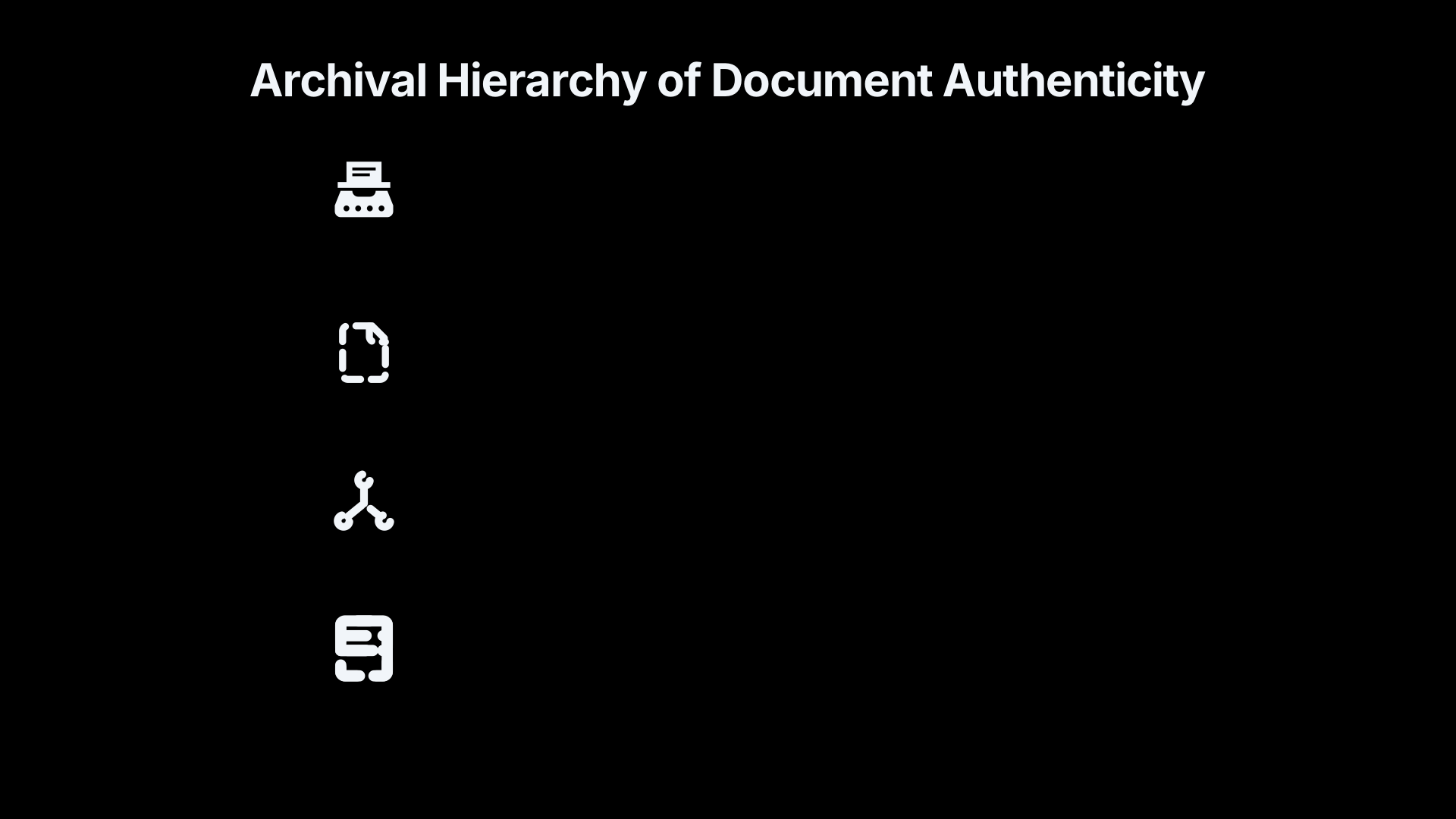
Document appearance remains valuable. Paper, ink, typewriters, seals and watermarks can eliminate obvious anachronisms or support a document’s claimed period. However, these features answer only part of the authentication question.
A record that fits naturally into a documented archive offers multiple, independent opportunities for verification through provenance, filing structure and related records. An isolated document offers comparatively few. For that reason, archivists and documentary historians generally regard archival placement as stronger evidence than visual authenticity alone.
Within debates over the alleged Magenta UFO crash, this means that the most persuasive future discoveries would not simply be additional impressive-looking documents. They would be records found within verifiable archival series whose surrounding files, registers and administrative context independently support the claimed origin, allowing the documents to be tested against the wider documentary record rather than judged solely on appearance. publications.archivists.org.au+2files.archivists.org[publications.archivists.org.au]publications.archivists.org.auISO 15489 and the varieties of forgeries in archivesDecember 15, 2015 — by J Kastenhofer · 2015 · Cited by 24 — Archives Code of Ethics s…
Amazon book picks
Further Reading
Books and field guides related to Does the document belong where it was found?. Use these as the next step if you want deeper reading beyond the article.
UFOs : Generals, Pilots, and Government Officials Go on the R...
Discusses documentary and official-source evidence.
The Demon-Haunted World: Science as a Candle in the Dark
Encourages evidence-based evaluation.

eBay marketplace picks
Marketplace Samples
Live-tested eBay searches with available results related to this page.




Endnotes
1.
Source: publications.archivists.org.au
Link:https://publications.archivists.org.au/index.php/asa/article/download/10605/10933
Source snippet
ISO 15489 and the varieties of forgeries in archivesDecember 15, 2015 — by J Kastenhofer · 2015 · Cited by 24 — Archives Code of Ethics s...
Published: December 15, 2015
2.
Source: files.archivists.org
Link:https://files.archivists.org/pubs/free/SAA-Glossary-2005.pdf
Source snippet
A glossary of archival and records terminology / Richard Pearce-Moses.Read more...
3.
Source: Wikipedia
Title: Archival science
Link:https://en.wikipedia.org/wiki/Archival_science
Additional References
4.
Source: researchgate.net
Link:https://www.researchgate.net/publication/320593846A_Literature_Review_of_Authenticity_of_Records_in_Digital_Systems_From%27Machine-Readable%27_to_Records_in_the_Cloud
Source snippet
(PDF) A Literature Review of Authenticity of Records in...24 Oct 2017 — This paper presents a review of the literature about authenticit...
5.
Source: dokumen.pub
Title: encyclopedia of archival science 9780810888104 9780810888111 0810888106
Link:https://dokumen.pub/encyclopedia-of-archival-science-9780810888104-9780810888111-0810888106.html
Source snippet
Encyclopedia of archival science 9780810888104...Here is the first-ever comprehensive guide to archival concepts, principles, and pract...
6.
Source: nemo.inf.ufes.br
Title: br Ontological Representation of Archival Records
Link:https://nemo.inf.ufes.br/wp-content/papercite-data/pdf/ontological_representation_of_archival_records_2025.pdf
Source snippet
Representation of Archival Records - NemoThis research was based on archival concepts and principles, such as provenance and context of d...
7.
Source: scribd.com
Title: The Encyclopedia of Archival Science | PDFThe Encyclopedia of Archival Science
Link:https://www.scribd.com/document/667584997/The-Encyclopedia-of-Archival-Science
Source snippet
Free download as PDF File (.pdf), Text File (.txt) or read online for free...
8.
Source: magazine.arma.org
Title: 2017 03 IM ISO15489 updated findlay
Link:https://magazine.arma.org/wp-content/uploads/simple-file-list/2017_03_IM_ISO15489_updated_findlay.pdf
Source snippet
for the Digital Age - ISO 15489 - ARMA Magazineby C Findlay · 2017 · Cited by 10 — This article describes how the standard has left open...
9.
Source: youtube.com
Title: How to evaluate the reliability of historical sources
Link:https://www.youtube.com/watch?v=IbCr1aGS4CQ
Source snippet
2 Archives Basics: Where to Start in an Archival Collection...
10.
Source: brainscape.com
Link:https://www.brainscape.com/flashcards/standards-5932852/packs/9031147
Source snippet
Standards Flashcards by Ross SpencerInformation and documentation – Records management – Part 2: Guidelines. ISO 15489 is the first stand...
11.
Source: youtube.com
Title: Archives Basics: Where to Start in an Archival Collection
Link:https://www.youtube.com/watch?v=w2mBVGkI16A
Source snippet
3 When Fake Archaeology Uses Fake Science...
12.
Source: papers.ssrn.com
Link:https://papers.ssrn.com/sol3/Delivery.cfm/5031392.pdf?abstractid=5031392&mirid=1
Source snippet
on Information and Archival Studies III IIIHe is a leading auditor of records management and archiving standards (ISO 15489, ISO...
13.
Source: youtube.com
Title: How to Fact-Check History | Retro Report
Link:https://www.youtube.com/watch?v=Lzr2e0rl_KY
Source snippet
5 Unpacking Provenance | A Himalayan Phurba...
Topic Tree