Within Supporters
Why the anonymous file trail matters
The alleged documents gained attention through anonymous deliveries, leaving the chain of custody too fragile for confirmation.
On this page
- How the documents reportedly arrived
- What a secure provenance chain would show
- Why lost or untraceable originals create doubt
Page outline Jump by section
Introduction
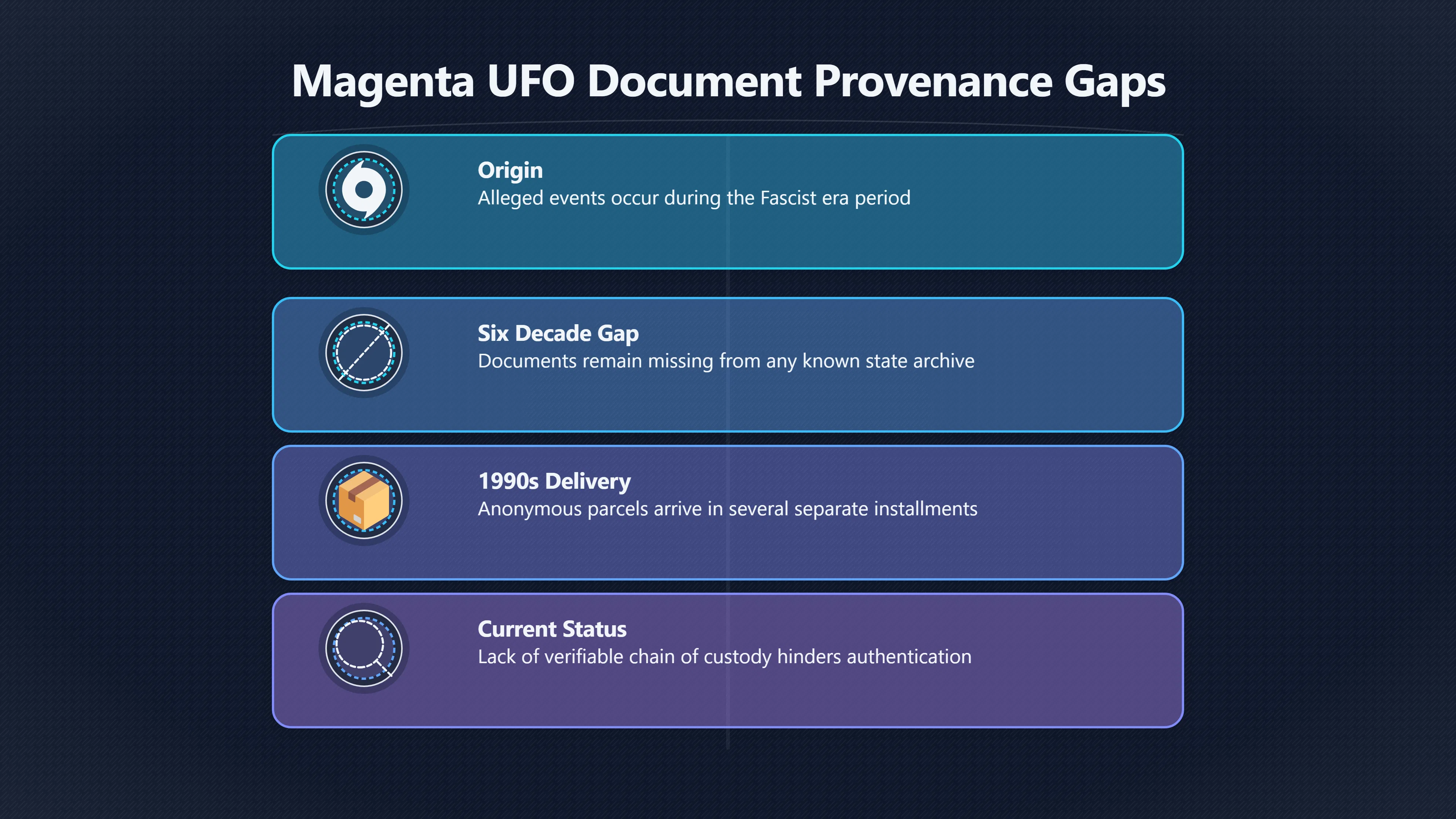
A central weakness in the alleged Magenta UFO case is not simply what the purported Fascist-era documents claim, but how they reportedly entered the public domain. According to Roberto Pinotti’s account, the papers arrived anonymously in a series of deliveries beginning in the 1990s, allegedly from someone connected to a former member of the supposed RS/33 cabinet. That origin story means the documents lack a verifiable chain of custody—a documented record showing who possessed them, where they were stored, and how they reached researchers. Regardless of whether individual pages appear old or contain historically plausible language, the absence of a secure provenance trail makes independent authentication extremely difficult and leaves open multiple competing explanations, including misunderstanding, selective preservation, alteration or deliberate fabrication.[Wikipedia]WikipediaIncidente di MagentaIncidente di Magenta
How the documents reportedly arrived
Pinotti has consistently stated that the alleged RS/33 papers were not discovered in a recognised state archive or institutional collection. Instead, they were said to have been sent anonymously in several instalments, with the sender’s identity withheld and the claimed family connection remaining unverified in public. The story therefore begins with an evidential gap: neither historians nor archivists can independently establish where the documents spent the six decades between the alleged events of 1933 and their appearance in the 1990s.[Wikipedia]WikipediaIncidente di MagentaIncidente di Magenta
That distinction matters because historical documents derive credibility from more than their contents. An official memorandum found within an established archive carries a documented relationship to surrounding records, filing systems and administrative practices. Anonymous papers arriving outside any archival framework do not benefit from those contextual checks. Researchers must instead rely largely on the recipient’s account of how the material was obtained.
Supporters argue that anonymity may have been understandable if descendants feared publicity or wished to protect family privacy. That possibility cannot be ruled out entirely. However, while anonymity may explain why a source stayed hidden, it does not compensate for the evidential problems created by an undocumented transfer history.
What a secure provenance chain would show
Professional historians, archivists and forensic document specialists distinguish between the authenticity of a physical object and the provenance of that object. A document may genuinely be old while its historical interpretation remains uncertain.
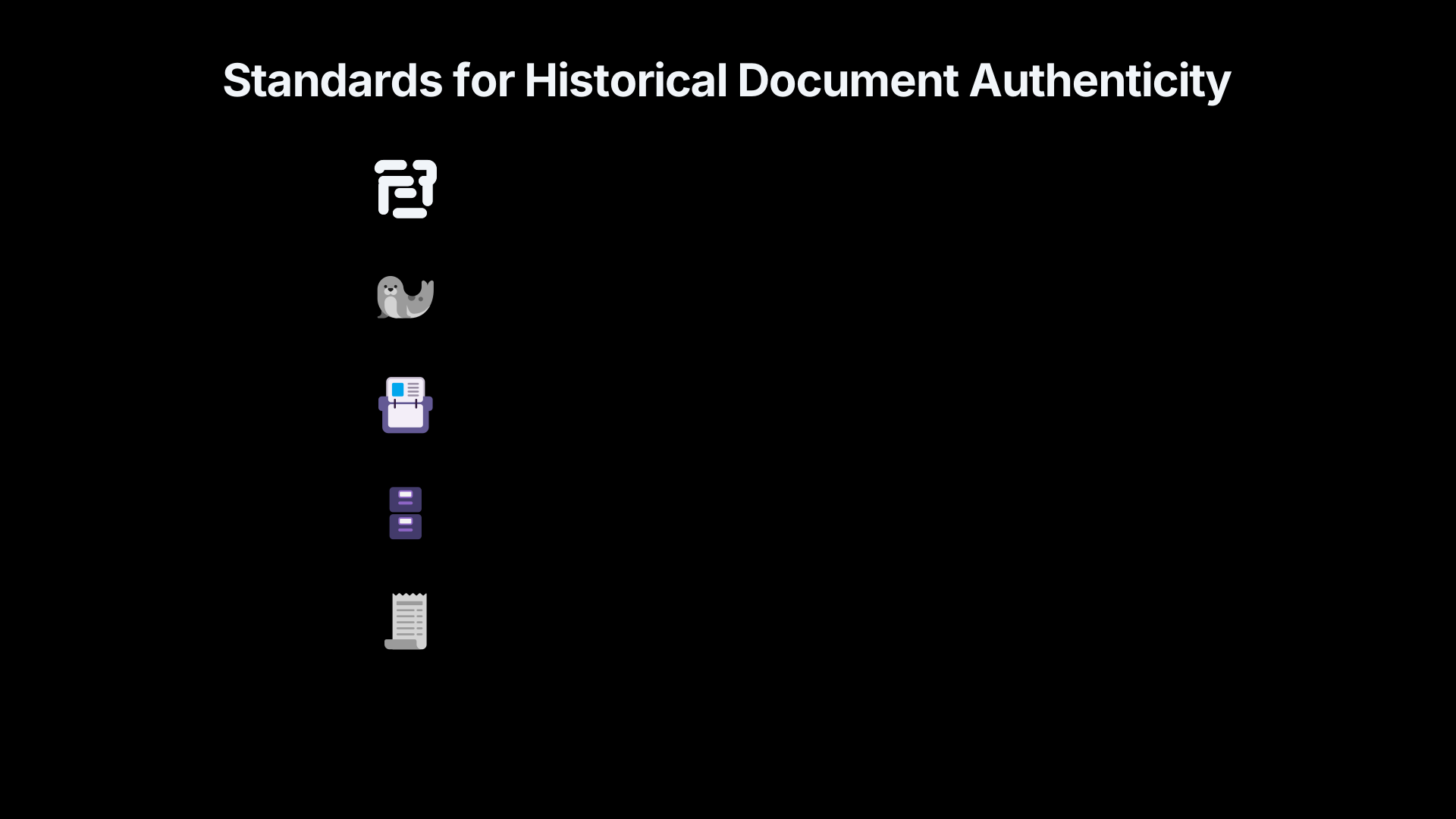
A robust provenance chain would normally answer questions such as:
- Where was the document stored over time?
- Who possessed it during each stage of its history?
- Can those transfers be independently documented?
- Does the document correspond to catalogued files, registry numbers or related official records?
- Can other records confirm that the document belonged within a known administrative series?
When those questions can be answered, researchers gain confidence that the document has not been substituted, altered or detached from its original context.
The reported RS/33 papers do not publicly satisfy these standards. Even if some physical characteristics were consistent with the Fascist period, the missing ownership history prevents investigators from demonstrating continuous custody from the 1930s to the present. That limits the strength of any conclusions drawn from material analysis alone.[Wikipedia]WikipediaIncidente di MagentaIncidente di Magenta
Why lost or untraceable originals create doubt
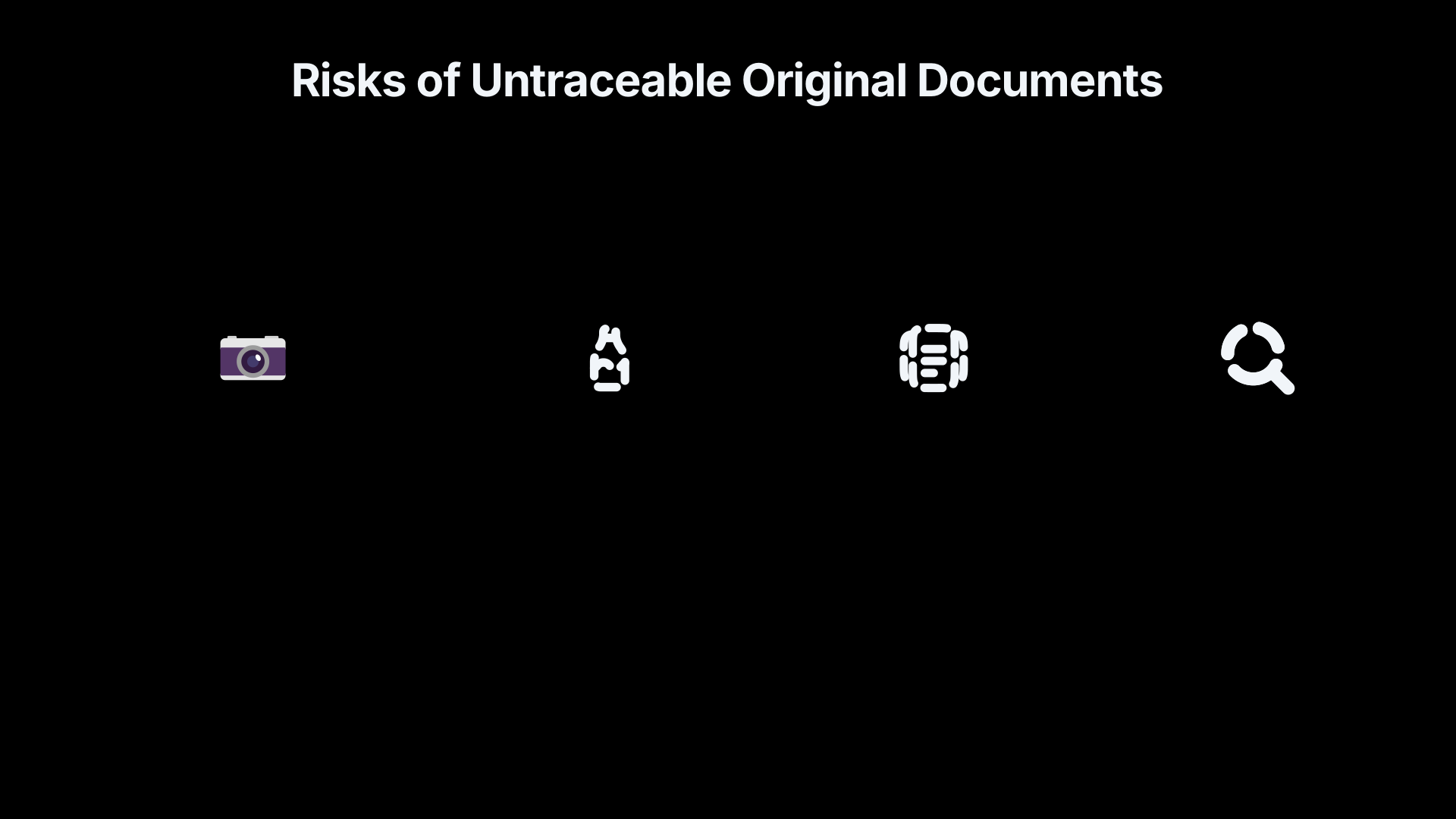
The reported history of the collection contains additional breaks beyond the anonymous deliveries themselves. Accounts associated with the case describe missing originals, incomplete collections and documents that allegedly disappeared after being shared or submitted for publication. Such gaps make later verification substantially harder because independent researchers cannot examine the same physical evidence or compare successive versions.
This creates several practical problems.
Independent replication becomes impossible. If later researchers cannot inspect the identical originals, they must depend on reproductions, photographs or previous descriptions rather than conducting their own forensic examination.
Alterations cannot easily be excluded. Without documented custody, it becomes difficult to determine whether annotations, damage, missing pages or other changes occurred before or after the documents entered public circulation.
Context may be permanently lost. A single memorandum often gains meaning from neighbouring files, registry entries, covering letters or filing marks. Detached documents lose much of that contextual evidence.
These issues do not automatically prove forgery. They do, however, reduce the evidential value that historians can assign to the surviving material because important questions cannot be answered through documentation alone.
Why anonymous provenance shifts the burden of proof
Extraordinary historical claims require unusually strong supporting evidence. In the Magenta case, the anonymous file trail reverses the normal evidential process.
Instead of beginning with a documented archive that investigators can inspect independently, the claim begins with papers whose reported journey depends heavily on testimony from the researchers who received them. The documents therefore become both the primary evidence and the primary source for their own provenance.
This creates a circular problem. If the papers are authentic, they may explain why official records are scarce. But without an independently verified provenance, researchers cannot confidently establish that the papers themselves deserve to be treated as authentic historical records.
For that reason, critics generally regard the anonymous delivery history as one of the principal limitations of the Pinotti file trail. Even supporters who consider some documents potentially genuine acknowledge that the missing chain of custody prevents the collection from reaching the standard of independently verifiable historical evidence.[Wikipedia]WikipediaIncidente di MagentaIncidente di Magenta
Amazon book picks
Further Reading
Books and field guides related to Why the anonymous file trail matters. Use these as the next step if you want deeper reading beyond the article.

eBay marketplace picks
Marketplace Samples
Live-tested eBay searches with available results related to this page.



Endnotes
1.
Source: Wikipedia
Title: Incidente di Magenta
Link:https://it.wikipedia.org/wiki/Incidente_di_Magenta
2.
Source: Wikipedia
Title: Sergi Roberto
Link:https://en.wikipedia.org/wiki/Sergi_Roberto
Source snippet
Sergi RobertoSergi Roberto Carnicer born 7 February 1992) is a Spanish professional footballer. Mainly a central midfielder, he can al...
Published: February 1992
3.
Source: Wikipedia
Title: Roberto Baggio
Link:https://en.wikipedia.org/wiki/Roberto_Baggio
Source snippet
Roberto Baggiois an Italian former professional footballer who mainly played as a second striker, or as an attacking midfielder, altho...
4.
Source: transfermarkt.co.uk
Link:https://www.transfermarkt.co.uk/roberto-jimenez/leistungsdaten/spieler/37403
Source snippet
Career statsRoberto · Date of birth/Age: 10/02/1986 (40) · Citizenship: Spain Spain. Height: 1,92 m; Position: Goalkeeper. Former Interna...
Additional References
5.
Source: youtube.com
Link:https://www.youtube.com/channel/UCf3BbgoZSTbdhMgaPnPn12w
Source snippet
Roberto ZambiaOfficial YouTube Channel for Zambia's Multi award winning artist/Producer/Song Writer/ On-Air Presenter ROBERTO. 16M views...
6.
Source: instagram.com
Link:https://www.instagram.com/official1roberto/?hl=en
Source snippet
Roberto being an abbreviated version of my first and second name. I am the voice of the spirits before me...
7.
Source: robertocavalli.com
Link:https://www.robertocavalli.com/en-gb/
8.
Source: youtube.com
Link:https://www.youtube.com/watch?v=44q2oxgNJ7Q
Source snippet
1933 Italy UFO crash documents authenticity UFO CRASH LANDS IN ANTARCTICA | The Proof Is Out There | #Shorts | History HISTORY...
9.
Source: youtube.com
Link:https://www.youtube.com/watch?v=PiPeptPgLYs
Source snippet
Jesse Michels and Robert Salas talking about the 1933 Magenta, Italy UFO crash-retrieval...
10.
Source: robertocarlos.com
Title: PROFILE S BRAZILIAN MUSIC
Link:https://www.robertocarlos.com/no-mundo/profiles-brazilian-music-roberto-carlos/
Source snippet
PROFILES BRAZILIAN MUSIC - Roberto CarlosRoberto Carlos symbolises unity. There is a simplicity to his voice, a rare ability to synthesis...
11.
Source: youtube.com
Link:https://www.youtube.com/watch?v=19oMz_WJZXs
Source snippet
The Magenta Project: The 1933 Italy UFO Crash-Retrieval That Changed the World...
12.
Source: youtube.com
Link:https://www.youtube.com/watch?v=l7S8KnXePJI
Source snippet
The 1933 Magenta UFO Crash: Mussolini’s Alien Cover-Up in Italy...
13.
Source: open.spotify.com
Link:https://open.spotify.com/artist/0t8NlZqAvwg7B5h9abux6l
Source snippet
Robert Chindamba Banda, on 17th December in Chipata, Roberto is the last born...
14.
Source: youtube.com
Link:https://www.youtube.com/watch?v=FGiwgyLY7Aw
Source snippet
Italy’s UFO Crash Before [Roswell]({{ 'roswell/' | relative_url }})? The 1933 Magenta Incident Revealed...
Topic Tree