Within Object Shape
How Words Changed the Magenta Craft
Small wording shifts can move the Magenta object from an unknown aircraft to a saucer, craft, spaceship or bell-shaped device.
On this page
- Neutral aircraft wording versus UFO media wording
- How translated labels create visual expectations
- The trust problem when terms keep shifting
Page outline Jump by section
Introduction
The Magenta story illustrates how translation can subtly transform an unidentified aircraft into what readers imagine as an alien spacecraft. This does not necessarily happen through a single mistranslation. Instead, a series of small wording changes—across languages, summaries and retellings—gradually shifts the meaning from a cautious description of an unknown flying object to a narrative centred on extraterrestrial technology. In the Magenta case, this process is especially significant because there is no verified contemporary technical report available for comparison. Most public descriptions derive from documents published decades after the alleged 1933 event and from later interpretations of those documents.[Wikipedia]WikipediaIncidente di MagentaIncidente di Magenta
 Understanding this translation drift helps explain why later accounts often describe a “spaceship” even when earlier or more neutral wording merely refers to an unidentified aircraft or flying object. It also explains why different readers come away with dramatically different mental images while referring to what is supposedly the same incident.
Neutral aircraft wording versus UFO media wording
One of the most important distinctions in the Magenta literature is between descriptive language and interpretive language.
The Italian material commonly uses expressions equivalent to:
- an unidentified aircraft
- an unknown aircraft
- a circular aircraft
- an unidentified flying object[Wikipedia]WikipediaSource details in endnotes.
The key word velivolo simply means an aircraft, flying vehicle or aerial craft. By itself, it does not imply extraterrestrial origin. Likewise, describing something as “non identified” merely acknowledges that its identity is unknown at that point.[Wikipedia]WikipediaIncidente di MagentaIncidente di Magenta
As the story moved into English-language UFO writing, the vocabulary often became more specific and more dramatic. Terms such as:
- flying saucer
- alien craft
- extraterrestrial vehicle
- spaceship
appear increasingly frequently in secondary summaries. Each step narrows the range of possible interpretations. “Unknown aircraft” leaves open many explanations, while “spaceship” already assumes an extraordinary origin.
This distinction matters because translation is not merely linguistic. It can also become interpretive editing, especially when translators already believe the underlying story concerns extraterrestrials.
How translated labels create visual expectations
Words influence how readers picture an object before they encounter any description of its appearance.
For example:
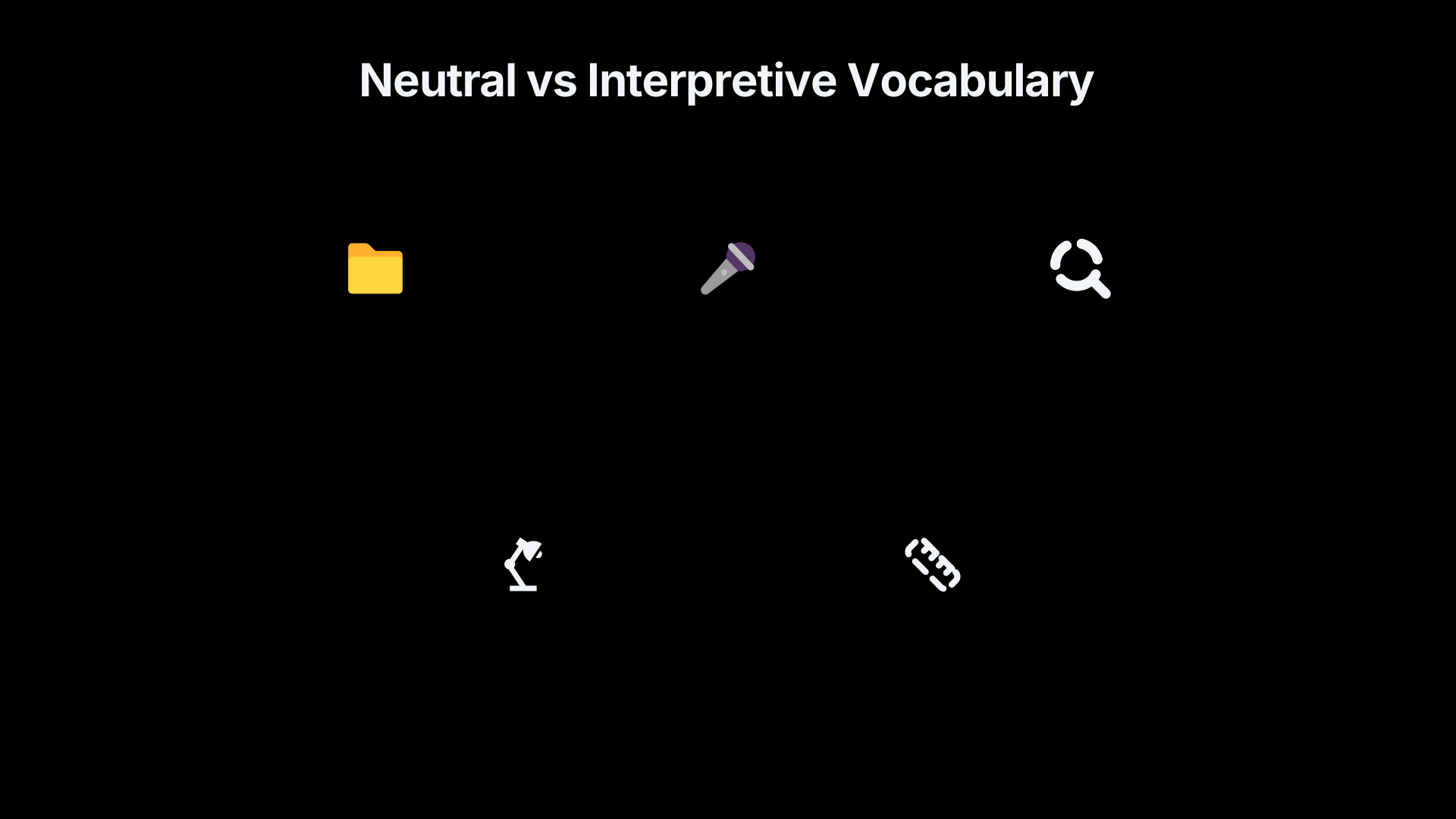
Neutral wordingTypical mental imageUnknown aircraftExperimental aeroplane or unfamiliar aviation technologyCircular aircraftDisc-shaped aircraft of unknown originFlying saucerClassic post-1947 UFOAlien craftExtraterrestrial vehicleSpaceshipAdvanced technological vehicle from another world
Once the phrase “spaceship” is introduced, later descriptions tend to become more elaborate. Readers become more receptive to details such as seamless metal, exotic propulsion or recovered occupants because those expectations are already embedded in the chosen vocabulary rather than emerging from the original description itself.
This process is well recognised in translation studies and historical research. Translators often must choose between preserving literal ambiguity or replacing it with a more familiar expression. In controversial historical cases, that choice can significantly alter how later audiences understand the evidence.
Small wording changes accumulate
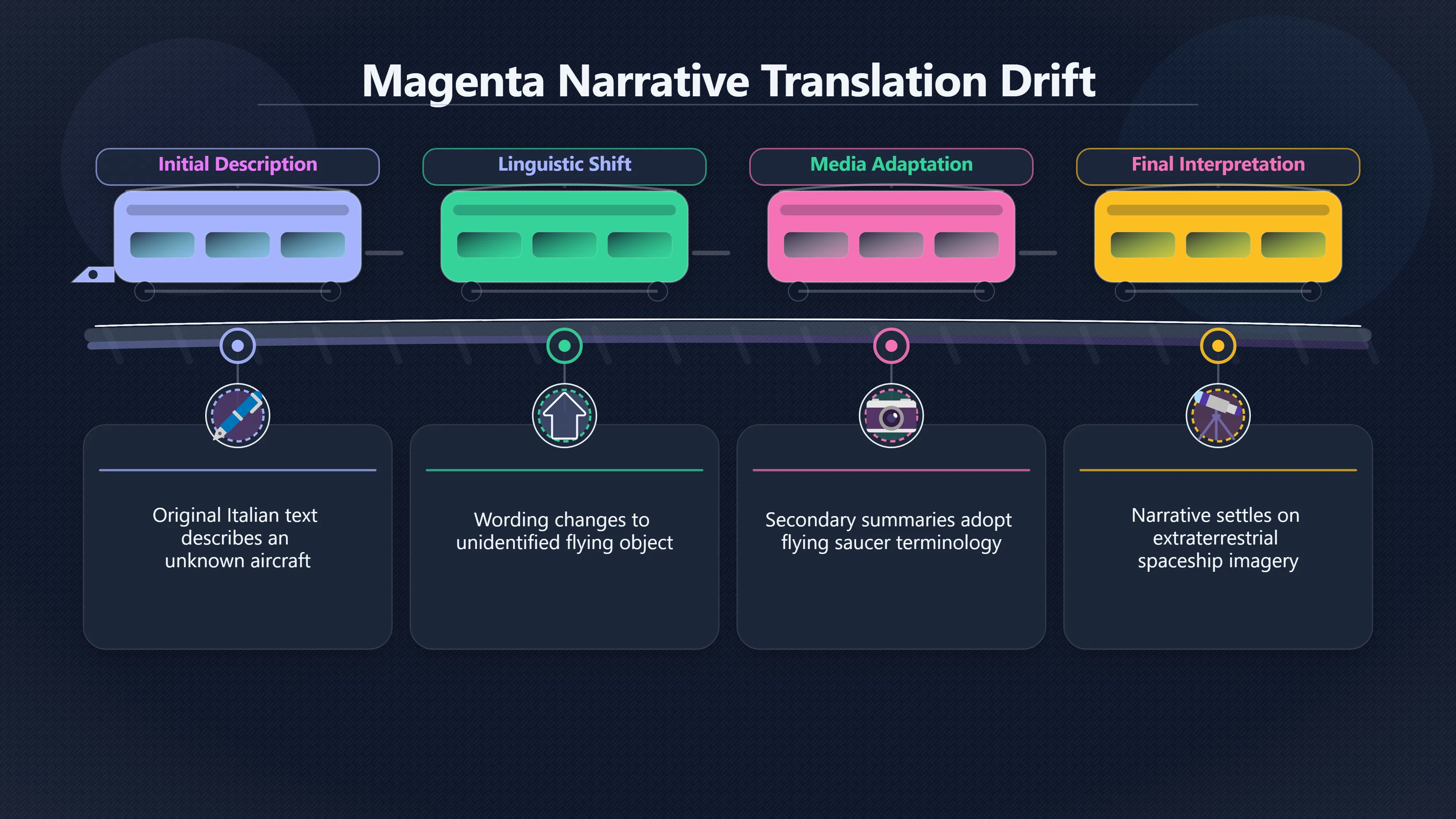
No single translation usually transforms the Magenta object into an alien spacecraft. Instead, several incremental shifts accumulate.
A common sequence looks like this:
- Unknown aircraft
- Unidentified flying object[Wikipedia]WikipediaSource details in endnotes.
- Flying saucer
- Recovered craft
- Alien craft
- Spaceship
Each individual substitution appears relatively modest. Together they produce a substantially different narrative.
The effect becomes even stronger when later authors quote earlier English summaries instead of returning to the Italian wording. Over successive retellings, interpretive language can become mistaken for original source language.
Why the post-1947 vocabulary matters
Another complication is chronology.
The alleged Magenta incident is dated to 1933, yet expressions such as “flying saucer” became globally popular only after the 1947 Kenneth Arnold sighting in the United States. Consequently, descriptions of a 1933 object as a “flying saucer” almost certainly reflect later retelling rather than contemporary Italian terminology.[Wikipedia]WikipediaUFO sightings in ItalyUFO sightings in Italy
That does not automatically invalidate the underlying claim, but it does show that the language surrounding the event has been modernised. Modern UFO vocabulary carries cultural associations that readers naturally project backwards onto an earlier period.
The result is that today’s audience often imagines a classic saucer-shaped extraterrestrial vehicle even though no authenticated 1933 report using that terminology has been produced.
Translation and the changing shape of the object
Translation drift also interacts with the changing physical descriptions associated with Magenta.
Italian summaries variously describe:
- a circular aircraft
- a metallic object
- two discs joined together
- a hemispherical structure
These descriptions already differ from one another before translation. When English writers selectively translate one version as a “flying saucer” and another as an “alien craft”, the visual differences become amplified rather than reduced.[Wikipedia]WikipediaIncidente di MagentaIncidente di Magenta
Readers may therefore believe multiple independent witnesses consistently described a spacecraft, when in reality they are encountering different translated versions of already inconsistent descriptions.

The trust problem when terms keep shifting
For historians, linguists and document analysts, unstable terminology raises an important question: which wording belongs to the earliest available source, and which belongs to later interpretation?
The Magenta case presents several reasons for caution:
- the alleged documents surfaced only in the late 1990s;
- many readers encounter them through English-language summaries rather than the original Italian material;
- different publications alternate between “aircraft”, “craft”, “flying saucer” and “spaceship”;
- the terminology often becomes more specific as the story moves further from the claimed primary documents.[Wikipedia]WikipediaIncidente di MagentaIncidente di Magenta
None of these observations proves or disproves the alleged incident itself. They do demonstrate, however, that the language used to describe the object has not remained stable.
For that reason, careful analysis should distinguish between what the earliest available wording actually says and what later UFO literature encourages readers to imagine. In the Magenta narrative, the progression from an unidentified aircraft to an extraterrestrial spaceship is often less a matter of new evidence than of cumulative translation and reinterpretation.
Amazon book picks
Further Reading
Books and field guides related to How Words Changed the Magenta Craft. Use these as the next step if you want deeper reading beyond the article.
They Are Already Here
Directly examines how culture, media, and language shape perceptions of UFO reports.

UFOs : Generals, Pilots, and Government Officials Go on the R...
Contrasts evidence-based reporting with speculation, complementing discussion of wording and interpretation.

Is That a Fish in Your Ear?
Explains how translation choices alter meaning, supporting the article's discussion of translation drift.
The UFO Encyclopedia
Provides broad context for famous UFO cases, including how reports and narratives evolve over time.
eBay marketplace picks
Marketplace Samples
Live-tested eBay searches with available results related to this page.


Endnotes
1.
Source: Wikipedia
Title: Incidente di Magenta
Link:https://it.wikipedia.org/wiki/Incidente_di_Magenta
2.
Source: Wikipedia
Title: UFO sightings in Italy
Link:https://en.wikipedia.org/wiki/UFO_sightings_in_Italy
3.
Source: Wikipedia
Link:https://it.wikipedia.org/wiki/UFO
Additional References
4.
Source: youtube.com
Link:https://www.youtube.com/watch?v=l7S8KnXePJI
Source snippet
Mussolini UFO Magenta 1933 crash [Fascist UFO files]({{ 'fascist-files/' | relative_url }}) The 1933 Magenta UFO Crash in Italy – Mussolini’s Secret Recovery?...
5.
Source: youtube.com
Link:https://www.youtube.com/watch?v=19oMz_WJZXs
Source snippet
Italy's Fascist UFO Files - Your Need to Know - OpenMindsTV -- The 1933 Magenta, Italy UFO/UAP...
6.
Source: youtube.com
Title: Italy’s Fascist UFO Files
Link:https://www.youtube.com/watch?v=VAk7eqP_GE8
Source snippet
Italy’s UFO Crash Before [Roswell]({{ 'roswell/' | relative_url }})? The 1933 Magenta Incident Revealed #BeforeRoswell...
7.
Source: instagram.com
Link:https://www.instagram.com/p/DVYMSf-CJ0F/?hl=en
Source snippet
he Pope was involved” #ufo #uap #aliens #disclosure #...
8.
Source: youtube.com
Link:https://www.youtube.com/watch?v=FGiwgyLY7Aw
Source snippet
The 1933 Magenta UFO Crash: Mussolini’s Alien Cover-Up in Italy | Secret Files & Fascist Era Mystery...
9.
Source: philarchive.org
Link:https://philarchive.org/archive/MEYTIQ
Source snippet
DownloadItalian UFO researcher Roberto Pinotti has investigated the 1933 case since 1996, after receiving anonymous documents that includ...
10.
Source: youtube.com
Title: Historical History
Link:https://www.youtube.com/watch?v=4ww6ZZXHdHo
Source snippet
Roberto Pinotti al Simposio della Fondazione SOL con il caso dell'UFO di Mussolini Something is Up | Italia...
11.
Source: youtube.com
Link:https://www.youtube.com/watch?v=ehIYnh4jbxY
Source snippet
The 1933 Magenta, Italy UFO Crash...
Topic Tree