Within Custody
Before Testing, Prove the Sample Is Traceable
Before testing any alleged fragment, a lab would need intake records, packaging history, contamination notes and split-sample controls.
On this page
- What a lab should record before analysis
- Contamination controls for old metal samples
- Why unusual results still need provenance
Page outline Jump by section
Introduction
If someone presented a metal fragment and claimed it came from the alleged 1933 Magenta UFO crash, a competent laboratory would not begin by asking whether the alloy looked unusual. It would first ask whether the sample could be traced. Modern analytical laboratories treat provenance and chain of custody as part of the evidence itself because even the most sophisticated tests cannot establish where a fragment originated if its collection and handling history are unknown. International forensic practice emphasises that sample integrity depends on documented custody, secure packaging, controlled transfers and contamination prevention before any analytical work begins.[PMC+2The ANSI Blog]pmc.ncbi.nlm.nih.govPMCThe Chain of Custody in the Era of Modern Forensicsby T D’Anna · 2023 · Cited by 71 — The purpose of this work is to renew the interest and attention for the chain of custody in forensi…
 Within the Magenta case, this distinction is crucial. Regardless of how unusual any future analytical result might appear, a fragment lacking documented provenance would remain scientifically difficult to interpret because there would be no reliable way to connect it to the alleged historical recovery rather than to an unknown modern source.
What a lab should record before analysis
Before accepting a claimed Magenta fragment for testing, an accredited laboratory would normally require an intake package that establishes what the sample is, where it came from and how it reached the laboratory.
Typical intake documentation would include:
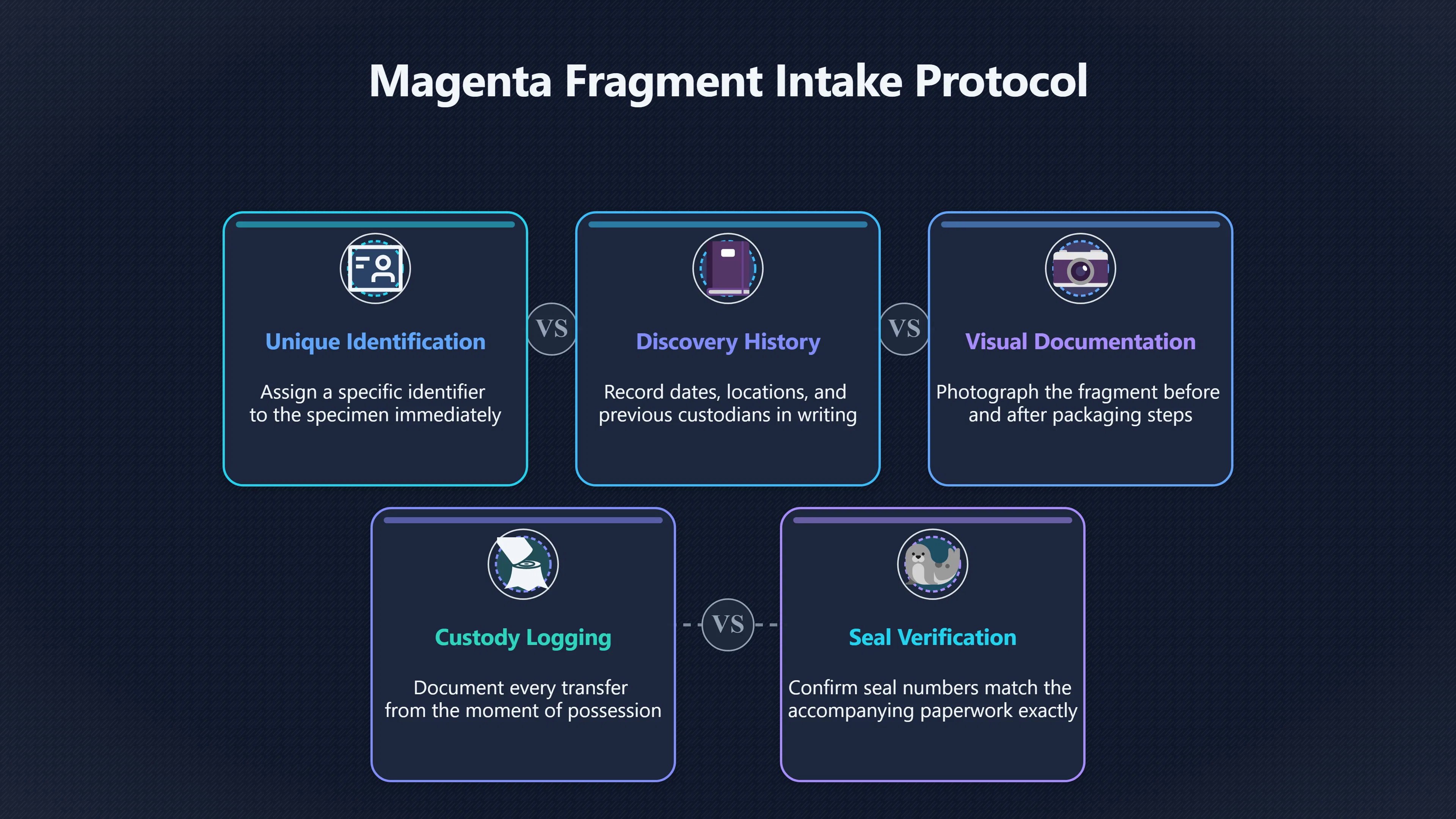
- A unique sample identifier assigned immediately upon receipt.
- The identity of the person submitting the specimen.
- A written account of the claimed discovery history, including dates, locations and previous custodians.
- Photographs showing the fragment before packaging and upon arrival.
- The condition of the packaging, including any signs of prior opening or damage.
- The sample’s mass, dimensions and visible surface condition.
- A complete custody log documenting every transfer from the moment the specimen entered documented possession.
- A declaration describing any previous analytical testing, cutting, polishing or cleaning.
Many laboratories also record whether the sample was received under sealed conditions, whether seal numbers match accompanying paperwork and whether discrepancies were observed during accession. Any inconsistency becomes part of the permanent laboratory record rather than being corrected informally. These procedures are standard because later analytical conclusions are only as defensible as the documentation established during intake.[agatlabs.com+2PMC]agatlabs.comand handling are required from receipt to sample disposition and disposal.Read more…
For an alleged Magenta fragment, laboratories would almost certainly request far more historical information than they would for an ordinary industrial sample because the claimed provenance is the central scientific question.
Contamination controls for old metal samples
Historical metal fragments present particular challenges because decades of storage, handling and environmental exposure can alter their surfaces.
A laboratory would therefore seek detailed information about:
- Whether the fragment has been cleaned with solvents, abrasives or acids.
- Whether adhesives, labels or conservation coatings have been applied.
- Storage environments, including humidity, containers and contact with other metals.
- Whether the object has been displayed publicly or handled repeatedly without gloves.
- Whether portions have already been removed for previous testing.
These questions matter because contamination can affect measurements of surface chemistry, corrosion products, isotopic composition and trace elements. Fingerprints, polishing compounds, machining oils, museum waxes and modern cutting tools may all leave detectable residues that complicate interpretation.
Consequently, many laboratories document contamination risks before sampling begins and may photograph every surface under controlled lighting before removing even a tiny specimen. Where practical, analysts distinguish between surface contamination and interior material by carefully recording where any analytical subsample was taken. Forensic guidance similarly stresses contamination prevention through controlled handling, secure packaging and documented laboratory procedures.[NIST+2UCLan - University of Central Lancashire]nist.govForensic Laboratory Standards for Prevention, Monitoring,Forensic Laboratory Standards for Prevention, Monitoring…May 8, 2020 — This standard covers aspects of limiting, detecting, asses…

Why split samples matter
For an object likely to attract controversy, laboratories often recommend preserving independent verification rather than consuming the entire specimen.
A scientifically robust intake process could therefore include:
- Retaining an untouched archive portion.
- Dividing the specimen into documented subsamples.
- Sealing reference material for future examination.
- Recording precisely which laboratory receives each portion.
- Maintaining identical custody documentation for every split sample.
Split-sample practice allows later researchers to repeat analyses or investigate alternative hypotheses without relying solely on one laboratory’s results. If destructive testing consumes the only available fragment without retaining authenticated reference material, independent verification becomes impossible.
For an alleged Magenta fragment, preserving independent material would be especially important because extraordinary historical claims require results that can be reproduced by multiple laboratories using different analytical techniques.
Why unusual laboratory results still need provenance
Suppose laboratory testing reported an uncommon alloy composition, unexpected isotopic ratios or manufacturing features that appeared difficult to explain. Such findings alone would not establish that the fragment originated from the alleged 1933 incident.
Scientific interpretation depends on two separate questions:
- What is the material?
- Can this specific object be shown to come from the claimed historical event?
Laboratory instruments answer the first question far more readily than the second.
An unusual composition might reflect experimental metallurgy, aerospace manufacturing, contamination, conservation treatments or incomplete comparison datasets. Without documented provenance linking the object continuously back to the alleged recovery, analytical findings cannot by themselves authenticate the historical claim. Chain-of-custody literature consistently treats traceability and analytical data as complementary rather than interchangeable forms of evidence.[PMC+2The ANSI Blog]pmc.ncbi.nlm.nih.govPMCThe Chain of Custody in the Era of Modern Forensicsby T D’Anna · 2023 · Cited by 71 — The purpose of this work is to renew the interest and attention for the chain of custody in forensi…
What would make a Magenta fragment suitable for testing?
From a modern laboratory perspective, the strongest submission would combine physical evidence with comprehensive documentation. Ideally, intake would include:
- An unbroken documented custody history.
- Original or contemporaneous records explaining when the fragment entered documented possession.
- Evidence that packaging remained secure during transfers.
- Full disclosure of previous handling and testing.
- Photographic documentation throughout the custody history.
- Sufficient preserved material for independent replication.
Absent those elements, a laboratory could still analyse the material’s composition, structure or age-related characteristics. What it could not do is convert those analytical results into proof that the fragment originated from the alleged Magenta crash. In that sense, provenance is not an administrative formality—it is a prerequisite for interpreting any scientific findings as evidence about the historical claim rather than simply about an unidentified piece of metal.
Amazon book picks
Further Reading
Books and field guides related to Before Testing, Prove the Sample Is Traceable. Use these as the next step if you want deeper reading beyond the article.

Criminalistics An Introduction to Forensic Science
First published 2014. Subjects: Criminal investigation, Medical jurisprudence, Chemistry, forensic, Forensic ballistics, Forensic Chemistry.
Forensic examination of glass and paint
First published 2001. Subjects: Paint, Criminal investigation, Identification, Glass, Forensic sciences.
Forensic science
First published 2002. Subjects: Forensic sciences, Forensische wetenschappen, Handbooks, manuals, Crime laboratories, Criminal Evidence.

Materials Characterization
First published 2009. Subjects: Materials, Textbooks, Analysis.
eBay marketplace picks
Marketplace Samples
Live-tested eBay searches with available results related to this page.




Endnotes
1.
Source: pmc.ncbi.nlm.nih.gov
Title: PMCThe Chain of Custody in the Era of Modern [Forensics]({{ ‘forensics/’ | relative_url }})
Link:https://pmc.ncbi.nlm.nih.gov/articles/PMC10000967/
Source snippet
by T D’Anna · 2023 · Cited by 71 — The purpose of this work is to renew the interest and attention for the chain of custody in forensi...
2.
Source: blog.ansi.org
Title: astm d4840 sample chain of custody procedures
Link:https://blog.ansi.org/ansi/astm-d4840-sample-chain-of-custody-procedures/
Source snippet
The ANSI BlogASTM D4840: Sample Chain-of-Custody Procedures...3 Feb 2022 — The ASTM D4840 guide contains a comprehensive discussion of p...
3.
Source: agatlabs.com
Link:https://agatlabs.com/wp-content/uploads/forensics-legal-sample-handling-protocol-client-responsibilities-guide-en.pdf
Source snippet
and handling are required from receipt to sample disposition and disposal.Read more...
4.
Source: nist.gov
Title: Forensic Laboratory Standards for Prevention, Monitoring,
Link:https://www.nist.gov/document/forensic-laboratory-standards-prevention-monitoring-and-mitigation-dna-contamination
Source snippet
Forensic Laboratory Standards for Prevention, Monitoring...May 8, 2020 — This standard covers aspects of limiting, detecting, asses...
Published: May 8, 2020
5.
Source: knowledge.lancashire.ac.uk
Link:https://knowledge.lancashire.ac.uk/id/eprint/46224/1/Maintaining%20the%20Chain%20of%20Custody%20Anti-Contamination%20Measures%20for%20Trace%20DNA%20Evidence.pdf
Source snippet
University of Central LancashireAnti-contamination measures for trace DNA evidenceby SK Alketbi · 2023 · Cited by 35 — As forensic techno...
6.
Source: youtube.com
Title: Chain of Custody
Link:https://www.youtube.com/watch?v=BlW6AwZ6r-s
Source snippet
Forensic Lesson: Evidence Collection & Chain of Custody...
Additional References
7.
Source: researchgate.net
Link:https://www.researchgate.net/publication/369940913_Maintaining_the_chain_of_custody_Anti-contamination_measures_for_trace_DNA_evidence
Source snippet
(PDF) Maintaining the chain of custody: Anti-contamination...11 Apr 2023 — Maintaining a clear chain of custody is critical to the admis...
8.
Source: linkedin.com
Link:https://www.linkedin.com/posts/astm-international_forensicscience-fsps-evidence-activity-7358503064711884800-h1VM
Source snippet
ASTM E30 standard for trace evidence collection and...A new standard being developed by ASTM's forensic sciences committee (E30) aims to...
9.
Source: labmanager.com
Link:https://www.labmanager.com/evidence-chain-of-custody-best-practices-building-trust-and-traceability-across-scientific-and-forensic-labs-34564
Source snippet
Evidence Chain of Custody Best Practices for LabsLearn how to strengthen your lab's evidence chain of custody with LIMS automation, audit...
10.
Source: facebook.com
Link:https://www.facebook.com/ASTMInternational/posts/a-new-standard-being-developed-by-astms-forensic-sciences-committee-e30-aims-to-/1152141223612324/
Source snippet
t, and store trace evidence while minimizing contamination...Read more...
11.
Source: youtube.com
Title: How to Complete a COC Record
Link:https://www.youtube.com/watch?v=d6F6nx1HPpQ
Source snippet
Evidence Collection Techniques in Forensic Science...
12.
Source: youtube.com
Title: Forensic Lesson: Evidence Collection & Chain of Custody
Link:https://www.youtube.com/watch?v=Cap9LgT7314
Source snippet
Laboratory Forensic Investigation...
13.
Source: youtube.com
Title: Laboratory Forensic Investigation
Link:https://www.youtube.com/watch?v=q2EzcTJ3xiY
Source snippet
How to Complete a COC Record...
14.
Source: youtube.com
Title: Evidence Collection Techniques in Forensic Science
Link:https://www.youtube.com/watch?v=IHHGnkDGCIQ
Topic Tree