Within Object Shape
Why Did Magenta Become a Flying Saucer?
The saucer label makes the 1933 claim sound familiar, but it also imports a post-1947 UFO image into an earlier story.
On this page
- The post 1947 saucer vocabulary problem
- How Pinotti's wording shaped public retellings
- What the label does and does not prove
Page outline Jump by section
Introduction
The description of the alleged 1933 Magenta object as a “flying saucer” is one of the clearest signs that the story has been shaped by later UFO culture rather than preserved in a fixed contemporary form. The expression “flying saucer” did not exist in popular use in 1933. It entered public vocabulary only after Kenneth Arnold reported seeing unusual objects near Mount Rainier in June 1947, when newspapers coined the phrase that quickly became synonymous with UFOs.

Wikipedia
That does not by itself disprove the Magenta claim. It does, however, raise an important historical question: why is an alleged pre-war incident so often described using terminology that originated fourteen years later? The answer lies less in the supposed 1933 event than in the way the story entered public circulation during the late twentieth century.
The post-1947 saucer vocabulary problem
The Magenta story reached an international audience largely through the work of Italian UFO researcher Roberto Pinotti, who publicised the alleged Fascist-era RS/33 documents after claiming to have received anonymous copies in the 1990s. English-language retellings frequently describe the recovered craft as a “flying saucer”, even though this wording would have been unavailable to any witness or official writing in 1933. Wikipedia
Wikipedia
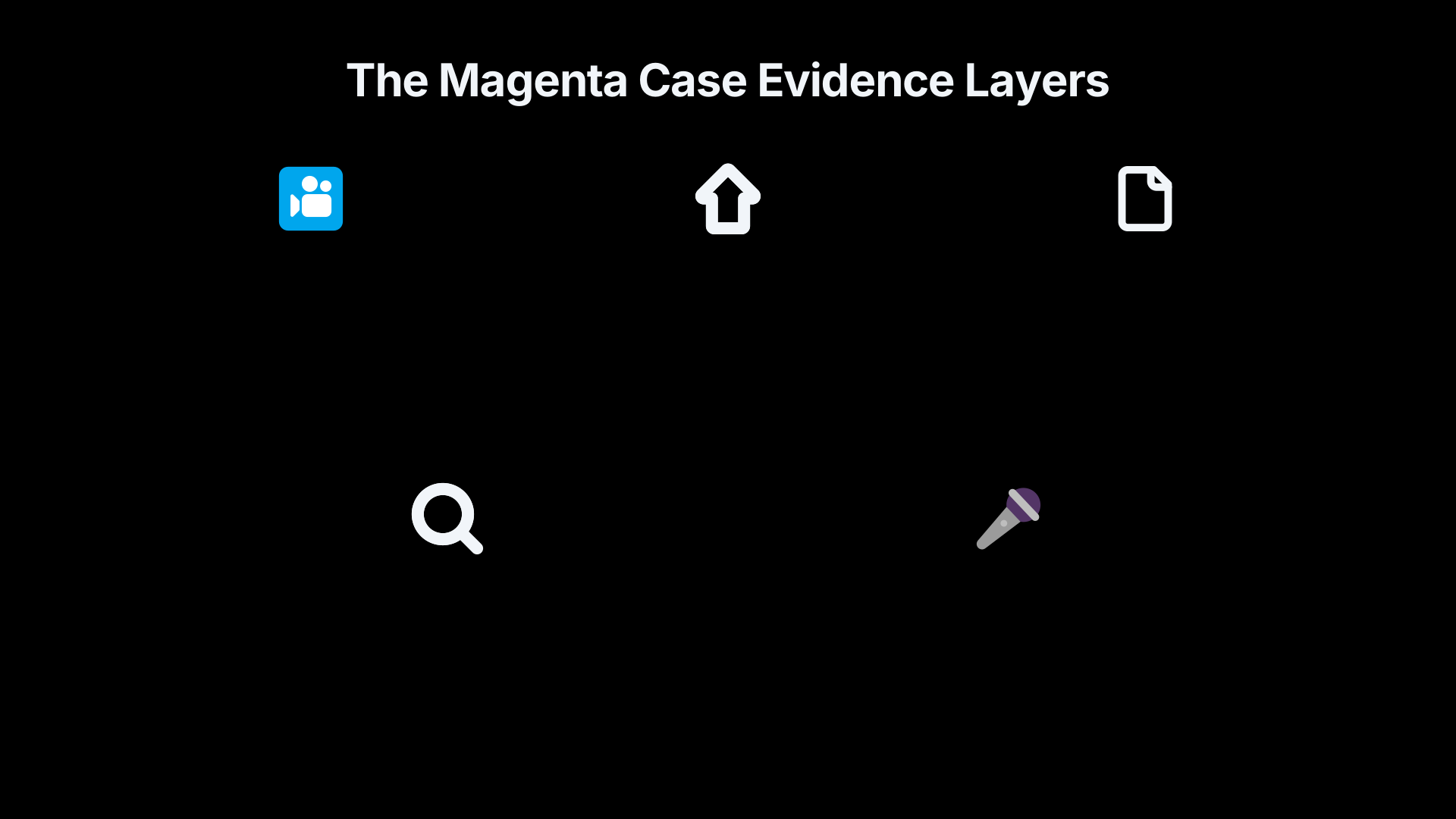
This matters because “flying saucer” is not a neutral geometric description. It carries a powerful cultural image created after 1947. Following Arnold’s sighting, newspapers rapidly standardised the phrase, and it became the dominant public label for unidentified aerial objects throughout the early Cold War. By the 1950s it was already associated with extraterrestrial visitors, even though Arnold himself had described the objects’ movement as resembling a saucer skipping across water, not necessarily their exact shape. Wikipedia
Wikipedia
As a result, describing the Magenta object as a “flying saucer” encourages modern readers to picture the classic silver disc familiar from post-war UFO folklore instead of asking what the alleged 1933 descriptions actually said.
How Pinotti’s wording shaped public retellings
The spread of the saucer label reflects how historical narratives evolve as they are translated, summarised and repeated.
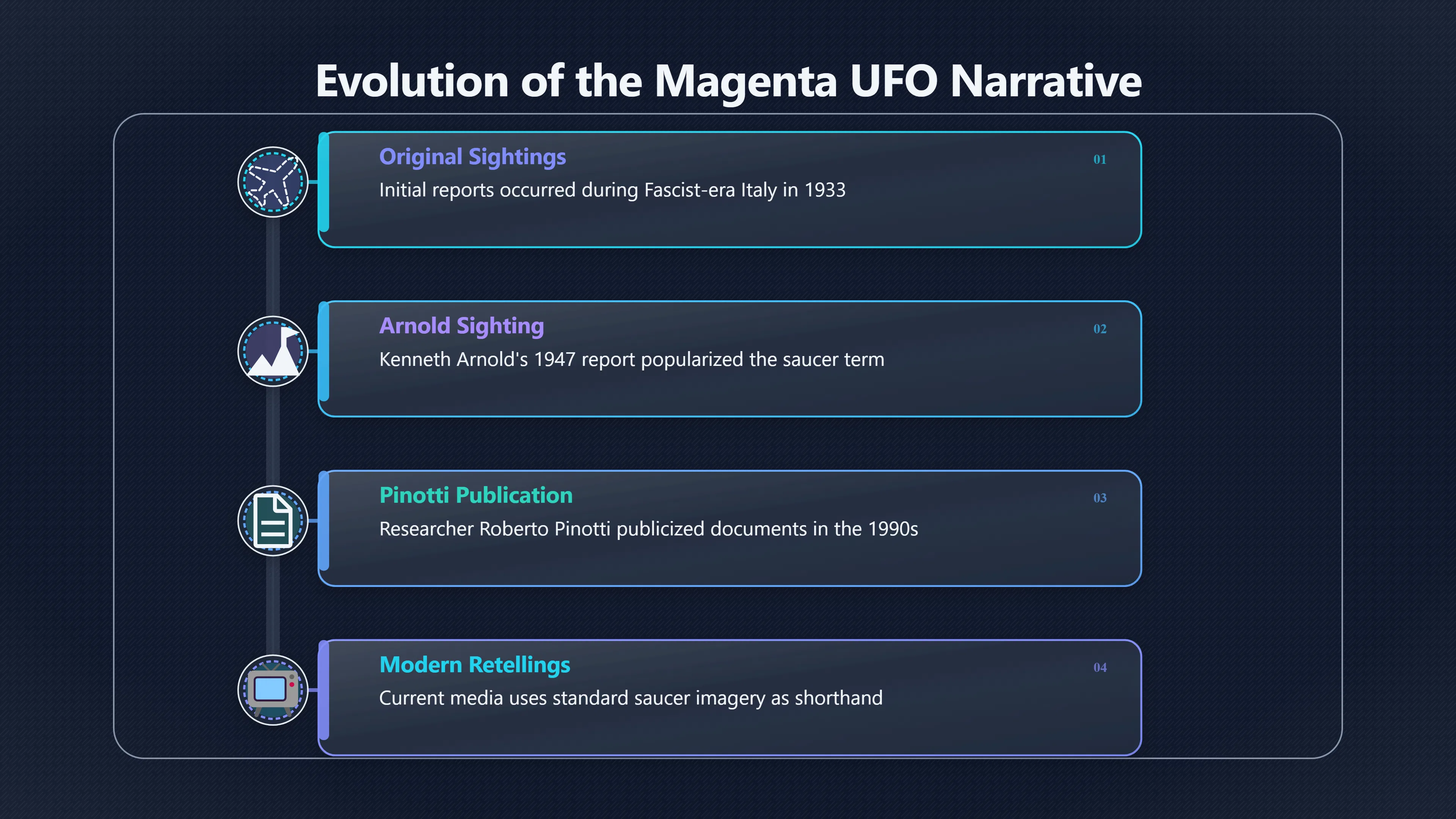
Pinotti’s publications and interviews introduced the Magenta story to audiences already accustomed to decades of UFO terminology. Subsequent articles, documentaries, websites and television programmes often adopted “flying saucer” as convenient shorthand because it was instantly recognisable. Once established, the phrase became self-reinforcing: later writers repeated it from earlier accounts rather than returning to the underlying descriptions.
Wikipedia
At the same time, Italian-language summaries preserve noticeably more variation than many English retellings. Instead of a single standard disc, the alleged object has been described as:
a circular aircraft with lights;
a grey metallic object approximately 15 metres across;
two discs joined together;
a large hemispherical structure roughly 10 metres high.
These are substantially different silhouettes rather than minor wording differences. A flat disc, a double-disc body and a tall hemispherical object would leave different impressions on observers and imply different engineering characteristics. The persistence of multiple incompatible descriptions suggests that the “flying saucer” image represents a later simplification rather than an original, stable observation.
Wikipedia
Historical studies of UFO culture note that reported craft often become standardised over time as stories are retold within an established cultural framework. The familiar saucer became a visual template into which many otherwise diverse reports were fitted after 1947.
Wikipedia
What the label does and does not prove
The appearance of post-1947 vocabulary in the Magenta story should not be treated as decisive evidence either for or against the alleged incident.
It does indicate that today’s commonly repeated description is partly a product of retrospective storytelling. A modern narrator naturally selects language that contemporary readers immediately understand. In that sense, calling the object a flying saucer says at least as much about late twentieth-century UFO culture as it does about an alleged event in Fascist Italy.
However, vocabulary alone cannot determine whether an underlying historical incident occurred. Even if an unusual aerial event had been reported in 1933, later authors might still describe it using familiar modern terminology without intending to claim that witnesses originally used those words.
The evidential issue therefore lies elsewhere. Historians ask whether there are contemporary documents, consistent witness accounts and verifiable archival records supporting a specific description. In the Magenta case, the surviving public narrative relies primarily on documents that surfaced decades later and whose object descriptions vary considerably across different retellings. The shift toward the universally recognisable “flying saucer” image should therefore be understood as evidence of narrative evolution rather than as independent evidence about the craft’s actual appearance. Wikipedia
Amazon book picks
Further Reading
Books and field guides related to Why Did Magenta Become a Flying Saucer?. Use these as the next step if you want deeper reading beyond the article.
The Demon-Haunted World
Helps readers assess how terminology and belief influence interpretation.
The UFO Experience
Discusses reporting conventions and changing descriptions of sightings.
The Report on Unidentified Flying Objects
Explains the early post-1947 flying saucer era that shaped later language.

UFOs : Generals, Pilots, and Government Officials Go on the R...
Contrasts modern investigations with historical claims.
eBay marketplace picks
Marketplace Samples
Live-tested eBay searches with available results related to this page.



Endnotes
1.
Source: Wikipedia
Title: Kenneth Arnold UFO sighting
Link:https://en.wikipedia.org/wiki/Kenneth_Arnold_UFO_sighting
2.
Source: Wikipedia
Title: Flying saucer
Link:https://en.wikipedia.org/wiki/Flying_saucer
3.
Source: Wikipedia
Title: Incidente di Magenta
Link:https://it.wikipedia.org/wiki/Incidente_di_Magenta
4.
Source: Wikipedia
Title: Unidentified flying object
Link:https://en.wikipedia.org/wiki/Unidentified_flying_object
Additional References
5.
Source: youtube.com
Title: Kenneth Arnold UFO Sighting The First UFOs
Link:https://www.youtube.com/watch?v=xLuHgsXGpqc
Source snippet
Kenneth Arnold and the First UFOs - Jimmy Akin's Mysterious World...
6.
Source: youtube.com
Title: Kenneth Arnold and the First UFOs
Link:https://www.youtube.com/watch?v=qdXNAOxs6mo
Source snippet
1st UFO Encounter Podcast - Pilot Kenneth Arnold, June 24, 1947...
Published: June 24, 1947
7.
Source: youtube.com
Title: The Magenta UFO case in Italy
Link:https://www.youtube.com/watch?v=OsniQnH7phU
Source snippet
Magenta città degli alieni? La storia dell'Ufo di Mussolini, il primo della storia...
8.
Source: youtube.com
Title: 1st UFO Encounter Podcast
Link:https://www.youtube.com/watch?v=qJ8eLw7YCMg
Source snippet
The Magenta UFO case in Italy...
Published: June 24, 1947
9.
Source: youtube.com
Link:https://www.youtube.com/watch?v=v82-YeEm91E
Topic Tree