Within Sceptics
Where are the Magenta witnesses?
A large recovery near Milan should have risked notice by locals, factory staff, soldiers, police, or transport workers.
On this page
- Who might have seen a recovery
- Why authoritarian secrecy may not explain everything
- What credible late testimony would need
Page outline Jump by section
Introduction
One of the strongest sceptical questions surrounding the alleged 1933 Magenta UFO crash is not about the disputed documents themselves, but about the apparent absence of independent witnesses. If an unusual craft really came down near the industrial area west of Milan and was recovered, transported and stored, many ordinary people might reasonably have been expected to encounter some part of the operation. Yet the public record contains no well-documented civilian testimony dating from the period, and later recollections remain sparse, indirect or difficult to verify.[philarchive.org]philarchive.orgDownloadEvidence points to a 1933 UFO crash in Magenta, Italy, recovered by the… Italian UFO researcher Roberto Pinotti has investigat…
 This absence does not prove that no recovery occurred. Wartime and authoritarian governments have concealed sensitive military activities before. However, sceptics argue that a large recovery operation is normally expected to leave more than a disputed documentary trail. It would also tend to generate memories, rumours, diaries, local reports or later testimony from people who happened to be nearby.
Who might have seen a recovery?
The alleged recovery has been described as taking place in northern Italy, with later accounts linking the object to facilities associated with the aviation industry around Vergiate and the Milan area. Even without accepting those claims, sceptics note that such an operation would potentially involve far more people than the small circle allegedly represented by the secret Cabinet RS/33.
Potential observers could have included:
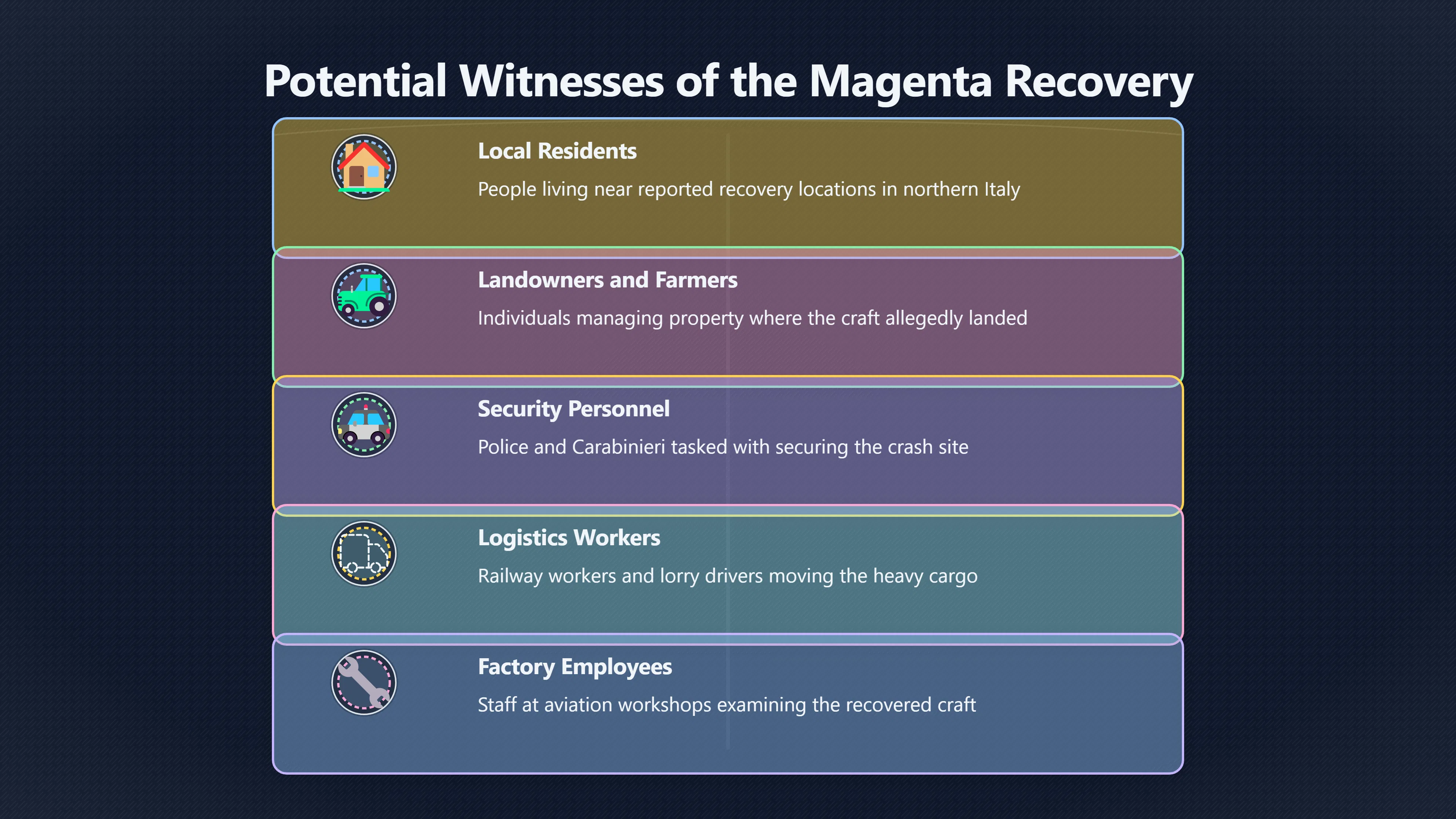
- Local residents living near the reported recovery location.
- Farmers or landowners if the object came down outside an urban area.
- Police or Carabinieri responsible for securing roads.
- Soldiers assigned to guard or transport unusual cargo.
- Railway workers or lorry drivers if the object required long-distance transport.
- Employees at aviation factories or workshops where the object was supposedly examined.
- Maintenance staff, clerks and administrative personnel who would ordinarily support a significant logistical operation.
None of these groups has produced a body of contemporaneous testimony that historians generally regard as independently corroborating the recovery story. Instead, the narrative continues to rely primarily on the contested documents circulated decades later.[philarchive.org]philarchive.orgDownloadEvidence points to a 1933 UFO crash in Magenta, Italy, recovered by the… Italian UFO researcher Roberto Pinotti has investigat…
Why authoritarian secrecy may not explain everything
Supporters sometimes argue that Fascist Italy’s security apparatus could have prevented information from spreading. It is true that Benito Mussolini’s regime censored newspapers, monitored political activity and exercised considerable control over public information.
Nevertheless, sceptics argue that censorship has practical limits.
A recovery involving a large physical object differs from suppressing a political speech or newspaper article. Moving heavy equipment, establishing security cordons, transporting unusual cargo and housing it in industrial facilities inevitably expands the number of people with at least partial knowledge of an event. Even if participants were ordered to remain silent, historians would generally expect at least some later recollections, memoirs, letters or family stories to emerge over many decades.
Comparable secret military programmes often remained officially classified while still generating numerous indirect witnesses whose accounts surfaced long after the events. Individual memories may be incomplete or contradictory, but they usually create an identifiable body of testimony. The Magenta case has not produced an equivalent civilian witness record.
The missing local historical footprint
Another sceptical observation concerns the broader historical record.
A remarkable recovery near Milan in 1933 might have been expected to leave traces beyond official files, even if newspapers never reported the true story. Researchers have looked for supporting material such as:
- Municipal records describing unusual road closures or emergency responses.
- Personal diaries mentioning an unexplained military presence.
- Factory correspondence hinting at an extraordinary project.
- Parish records or local memoirs recalling unusual activity.
- Oral histories collected decades later from residents of the area.
To date, publicly available evidence of this kind remains extremely limited. The lack of such collateral material does not conclusively disprove the alleged recovery, but it reduces opportunities for independent verification and leaves the disputed documentary record largely standing alone.[philarchive.org]philarchive.orgDownloadEvidence points to a 1933 UFO crash in Magenta, Italy, recovered by the… Italian UFO researcher Roberto Pinotti has investigat…

Why late witness testimony is difficult to evaluate
The passage of time creates additional problems.
By the time the Magenta documents became widely discussed in UFO literature during the 1990s, more than sixty years had elapsed since the alleged event. Many direct participants or potential observers would already have died, while surviving memories would inevitably have been influenced by age, later publications and public discussion.
Historians therefore distinguish between:
- Contemporaneous evidence, such as diaries, letters and official records created at the time.
- Independent later recollections, which can still be valuable if they can be traced to identifiable individuals whose accounts pre-date widespread publicity.
- Retrospective stories that only emerge after a case becomes famous, making it difficult to separate original memory from later influence.
The Magenta case contains relatively little publicly documented testimony in the first two categories.
What credible late testimony would need
Because the witness record is currently so limited, sceptics argue that genuinely persuasive new testimony would need to satisfy several criteria.
It would ideally come from an identifiable individual whose connection to the alleged recovery can be independently established, rather than from an anonymous source. The account should contain specific, verifiable details that were not already available in published UFO literature and should be capable of corroboration through employment records, military postings, family papers or other archival evidence.
Especially valuable would be multiple independent witnesses whose accounts agree on core facts while differing naturally on incidental details. Historians generally regard this pattern as more persuasive than several closely matching stories that appear to derive from a common published source.
Why the witness gap remains significant
Within the broader sceptical assessment of the alleged Magenta UFO crash, the absence of credible civilian witnesses is not presented as proof that the event never occurred. Rather, it is treated as an important missing piece of the evidential puzzle.
If a substantial recovery really took place in one of Italy’s most industrialised regions, many opportunities existed for ordinary people to observe at least fragments of the operation. The continued lack of well-documented, independently verifiable testimony from civilians, transport workers, factory employees or local officials therefore remains one of the principal unresolved questions surrounding the case, reinforcing sceptical concerns that the documentary claims have yet to acquire the broader historical support expected for an event of such scale.[philarchive.org]philarchive.orgDownloadEvidence points to a 1933 UFO crash in Magenta, Italy, recovered by the… Italian UFO researcher Roberto Pinotti has investigat…
Amazon book picks
Further Reading
Books and field guides related to Where are the Magenta witnesses?. Use these as the next step if you want deeper reading beyond the article.
UFOs : Generals, Pilots, and Government Officials Go on the R...
Provides context for major government-related UFO claims that AARO evaluated against documentary evidence.
The Demon-Haunted World: Science as a Candle in the Dark
Supports critical evaluation of anecdotal evidence.
The UFO Experience: A Scientific Inquiry
Examines witness testimony and case evaluation.
eBay marketplace picks
Marketplace Samples
Live-tested eBay searches with available results related to this page.



Endnotes
1.
Source: philarchive.org
Link:https://philarchive.org/archive/MEYTIQ
Source snippet
DownloadEvidence points to a 1933 UFO crash in Magenta, Italy, recovered by the... Italian UFO researcher Roberto Pinotti has investigat...
Additional References
2.
Source: youtube.com
Link:https://www.youtube.com/watch?v=PiPeptPgLYs
Source snippet
Italy’s UFO Crash Before [Roswell]({{ 'roswell/' | relative_url }})? The 1933 Magenta Incident Revealed...
3.
Source: youtube.com
Link:https://www.youtube.com/watch?v=CQiBnRAFXEo
Source snippet
1933 Magenta UFO crash witnesses evidence Exposing UFO Secrets: Italy's 1933 Alien Crash & America's Hidden Evidence | Joe Rogan, David G...
4.
Source: youtube.com
Link:https://www.youtube.com/watch?v=FGiwgyLY7Aw
Source snippet
The Magenta Project: The 1933 Italy UFO Crash-Retrieval That Changed the World -- Updated Supercut...
5.
Source: youtube.com
Link:https://www.youtube.com/watch?v=l7S8KnXePJI
Source snippet
Magenta 1933: The UFO Crash Before Roswell...
6.
Source: youtube.com
Title: Magenta UFO crash 🇮🇹🛸 NEW testimony and confirmed facts | Sabrina Pieragostini
Link:https://www.youtube.com/watch?v=QWA0PwxMU30
Source snippet
The 1933 Magenta, Italy UFO Crash...
Topic Tree