Within Aviation
Was Italy's strange jet really alien technology?
The N.1 looked futuristic, but its motorjet design follows a traceable Italian engineering path rather than a hidden alien leap.
On this page
- What the Caproni Campini N.1 actually was
- Why its timeline matters for Magenta claims
- Why poor performance weakens the leapfrogging theory
Page outline Jump by section
Introduction
The Caproni Campini N.1 is sometimes drawn into stories about the alleged 1933 Magenta UFO crash because it was an unusual Italian aircraft, it emerged during the Fascist era, and it looked strikingly futuristic. Those superficial similarities have encouraged claims that it represented the first successful attempt to reverse-engineer recovered alien technology. The historical record does not support that conclusion.
 Instead, the N.1 fits a well-documented and traceable engineering programme that began years before the alleged Magenta incident. Its propulsion system evolved from Italian research into reaction propulsion led by engineer Secondo Campini in the early 1930s, progressed through publicly documented government contracts, and culminated in an aircraft that was technologically ambitious but ultimately underpowered. Ironically, the aircraft’s disappointing performance is one of the strongest arguments against the idea that it benefited from any hidden technological breakthrough.[Wikipedia]WikipediaCaproni Campini N.1Caproni Campini N.1
What the Caproni Campini N.1 actually was
The Caproni Campini N.1 was not a turbojet aircraft in the modern sense. It used what is now called a motorjet: a conventional piston engine drove a compressor that forced air through a combustion chamber before the hot gases exited through a jet nozzle to generate thrust. Unlike later turbojets, the compressor was not powered by a turbine extracting energy from the exhaust stream.[Wikipedia]WikipediaCaproni Campini N.1Caproni Campini N.1
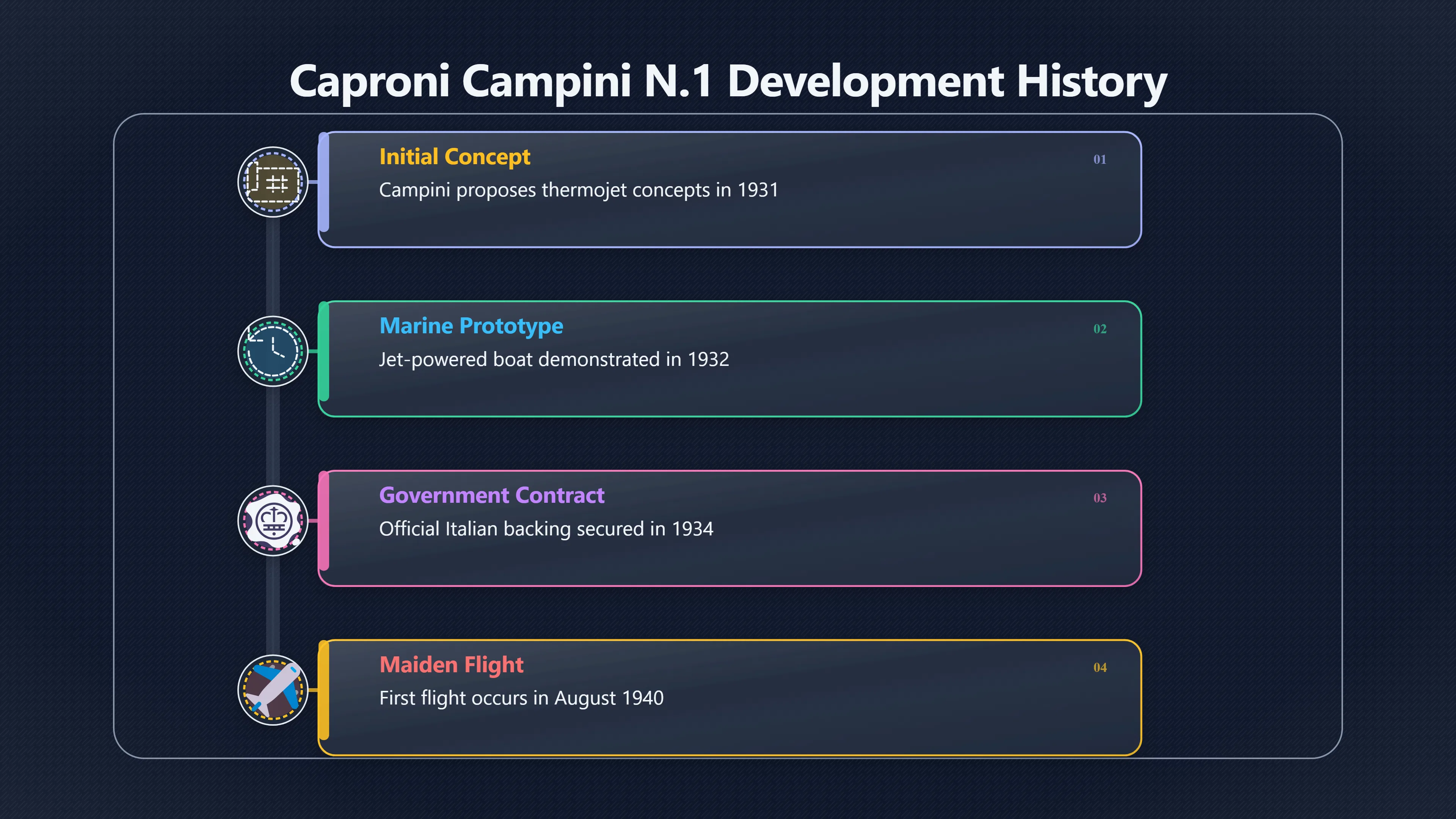
This distinction matters because the aircraft represented an evolutionary engineering experiment rather than an abrupt technological leap. Campini had proposed the underlying “thermojet” concept in 1931, demonstrated related reaction-propulsion ideas with a jet-powered boat in 1932, and secured official Italian government backing in 1934 before partnering with Caproni to build two experimental aircraft. The chronology is visible through surviving technical histories and aviation records rather than emerging suddenly from secret wartime files.[Wikipedia]WikipediaCaproni Campini N.1Caproni Campini N.1
The first flight took place on 27 August 1940 from Taliedo near Milan with test pilot Mario de Bernardi. At the time it briefly attracted worldwide attention because Germany’s earlier flight of the Heinkel He 178 remained secret, leading many observers to believe Italy had achieved the world’s first successful jet-powered flight. That reputation was revised only after the German programme became public.[Wikipedia]WikipediaCaproni Campini N.1Caproni Campini N.1
Why its timeline matters for Magenta claims
The reverse-engineering narrative depends on the assumption that the N.1 reflected knowledge unavailable through ordinary engineering development. The documented timeline points in the opposite direction.
Campini’s published interest in jet propulsion predates both the alleged 1933 Magenta crash and the aircraft’s construction. His proposals, government demonstrations and development contracts form a continuous sequence that historians can reconstruct from contemporary records. Rather than appearing as an unexplained technological jump after 1933, the project developed over nearly a decade through incremental experimentation.[Wikipedia]WikipediaCaproni Campini N.1Caproni Campini N.1
Equally important, the programme was not hidden in the way conspiracy theories would predict. Fascist Italy frequently publicised aviation projects to demonstrate national prestige. Historians have noted that the Campini programme received unusually open publicity compared with Britain’s and Germany’s more secretive jet efforts, reflecting the regime’s desire to showcase Italian innovation rather than conceal revolutionary technology.[Wikipedia]WikipediaCaproni Campini N.1Caproni Campini N.1
If the aircraft had genuinely embodied a successful exploitation of extraordinary recovered technology, its technical evolution would be expected to show sudden discontinuities or capabilities beyond contemporary engineering. Instead, surviving documentation shows familiar stages of proposal, funding, prototype construction, testing and revision.
Why poor performance weakens the leapfrogging theory
Perhaps the strongest argument against the reverse-engineering myth is the aircraft’s actual performance.
Although visually advanced, the N.1 was slower than many conventional piston-engined fighters already in service. Its propulsion system generated insufficient thrust for practical combat use, consumed fuel inefficiently and suffered from severe heat problems that forced pilots to fly with the cockpit canopy open during testing. The aircraft proved the concept of reaction propulsion but not an operationally useful solution.[Wikipedia]WikipediaCaproni Campini N.1Caproni Campini N.1
Several characteristics illustrate these limitations:
- The motorjet depended on a large conventional piston engine, reducing the efficiency advantages associated with later turbojets.
- Maximum speed remained inferior to contemporary high-performance fighters despite the aircraft’s unconventional appearance.
- Heat management became a persistent operational problem.
- Only two prototypes were completed, and the concept never entered production because more capable turbojet technology quickly overtook it.[Wikipedia]WikipediaCaproni Campini N.1Caproni Campini N.1
These shortcomings are exactly what historians expect from an ambitious experimental aircraft exploring a new propulsion concept. They are difficult to reconcile with the idea that designers possessed access to fundamentally superior technology.
Why the aircraft still attracts speculation
The N.1 occupies an unusual place in aviation history. Its smooth fuselage, internal jet propulsion and association with wartime Italy make it visually and historically distinctive. Combined with the enduring fascination surrounding alleged secret Fascist research projects, this has made it an attractive object for speculative narratives connected to Magenta.
However, unusual appearance should not be confused with unexplained origin. Many interwar experimental aircraft looked decades ahead of their time while still emerging from conventional engineering processes. The N.1 belongs in that category. It was innovative because Italian engineers pursued an unconventional propulsion pathway, not because it displayed technology without precedent or explanation.
Its later influence also followed understandable engineering lines. Although the motorjet itself proved to be a technological dead end compared with turbojets, related concepts informed later experimental work in several countries before more efficient gas-turbine engines became dominant.[Wikipedia]WikipediaCaproni Campini N.1Caproni Campini N.1
What the historical evidence suggests
Within discussions of the alleged Magenta UFO crash, the Caproni Campini N.1 is best understood as evidence of Italy’s genuine aeronautical ambition rather than evidence of successful alien reverse engineering.
The aircraft’s design can be traced to documented research beginning in 1931, its development followed a visible sequence of contracts and prototypes, and its disappointing operational performance reflects the limitations of pioneering human engineering rather than the exploitation of advanced external technology. Its significance lies in demonstrating how ambitious experimentation can later acquire an aura of mystery, even when the engineering history remains remarkably well documented.[Wikipedia]WikipediaCaproni Campini N.1Caproni Campini N.1
Amazon book picks
Further Reading
Books and field guides related to Was Italy's strange jet really alien technology?. Use these as the next step if you want deeper reading beyond the article.
Skunk Works
Shows how revolutionary aerospace technologies are documented and engineered.

The Illustrated Encyclopedia of Aircraft
Places the motorjet experiment among other aircraft innovations.

The jet race and the Second World War
Explains genuine jet and reaction-propulsion development without resorting to speculative origins.
Italian civil and military aircraft, 1930-1945
Directly covers the Caproni Campini N.1 and its documented development.
eBay marketplace picks
Marketplace Samples
Live-tested eBay searches with available results related to this page.
Endnotes
1.
Source: Wikipedia
Title: Caproni Campini N.1
Link:https://en.wikipedia.org/wiki/Caproni_Campini_N.1
2.
Source: Wikipedia
Title: Secondo Campini
Link:https://en.wikipedia.org/wiki/Secondo_Campini
3.
Source: reddit.com
Title: It flew using a domestically built motor jet, a rudimentary jet engine.Read more
Link:https://www.reddit.com/r/WeirdWings/comments/dojseh/caproni_campini_n1_almost_the_worlds_first_jet/
Source snippet
Caproni Campini N.1 - Almost the worlds first Jet AirplaneThe Caproni Campini N.1 first flew, touting itself as the worlds first jet airp...
4.
Source: fiddlersgreen.net
Title: Campini N1
Link:https://www.fiddlersgreen.net/models/aircraft/Campini-N1.html
Source snippet
Caproni Campini N.1 | Aircraft |The Caproni Campini N.1 flew in 1940 and has sometimes been touted as the world's first jet aircraft. N.1...
5.
Source: warmachinesdrawn.blogspot.com
Title: caproni campini n1
Link:https://warmachinesdrawn.blogspot.com/2019/06/caproni-campini-n1.html
Source snippet
Caproni Campini N.127 Jun 2019 — The Caproni Campini N.1 was an experimental aircraft, designed to demonstrate the feasibility of the jet...
Additional References
6.
Source: facebook.com
Title: today in aviation 27081940 first flight caproni campini n1in 1934 the regia aero
Link:https://www.facebook.com/SpotterMagMalta/posts/today-in-aviation-27081940-first-flight-caproni-campini-n1in-1934-the-regia-aero/1365352898929943/
Source snippet
First Flight Caproni Campini N.1 In 1934...The N.1s first flight was made by test pilot Mario De Bernardi at Caproni's facility in Tali...
7.
Source: planehistoria.com
Title: Plane Historia Italy built the first Successful Jet Aircraft
Link:https://planehistoria.com/caproni-campini-n-1/
Source snippet
Italy built the first Successful Jet Aircraft - Caproni Campini...21 Nov 2023 — The Caproni Campini N.1, It achieved its first flight in...
8.
Source: vintageaviationnews.com
Link:https://vintageaviationnews.com/warbird-articles/today-in-aviation-history-first-flight-of-the-caproni-campini-n-1.html
Source snippet
Vintage Aviation NewsFirst Flight of the Caproni Campini N.127 Aug 2025 — Eighty-five years ago today (August 27, 1940), the Caproni Camp...
Published: August 27, 1940
9.
Source: silverhawkauthor.com
Link:https://silverhawkauthor.com/aviation/warplanes-of-italy-regia-aeronautica-caproni-campini-n-1/
Source snippet
Warplanes of Italy: Regia Aeronautica, Caproni Campini N.1.The Caproni Campini N.1, also known as theC.C.2, is an experimental jet aircra...
10.
Source: stormomagazine.com
Title: STORM O!
Link:https://www.stormomagazine.com/ModelArticles/CaproniCampini/CC2/RichardMendes/CaproniCampiniN1_RM_1a.html
Source snippet
Valom 1/72 Caproni Campini N.1 by Richard...The first Italian jet aircraft made its maiden flight on May 28, 1940 and for a while this w...
Published: May 28, 1940
11.
Source: youtube.com
Link:https://www.youtube.com/live/r4j6s3zRdNY
Source snippet
's first jet to be shown off with pride...
12.
Source: youtube.com
Title: Italy’s Forgotten WWII Jet Program
Link:https://www.youtube.com/watch?v=7LQh94u8XAE
Source snippet
Caproni Campini N 1 The second successful jet powered aircraft in history...
13.
Source: youtube.com
Title: Caproni Campini N 1 The second successful jet powered aircraft in history
Link:https://www.youtube.com/watch?v=jA1ZBUVUeek
Source snippet
The Magenta UFO case in Italy...
14.
Source: youtube.com
Title: The ENGINE That Tried to Turn a Plane Into a Jet
Link:https://www.youtube.com/watch?v=NML45hTfRSE
Source snippet
The “first” WW2 jet fighter was Italian...
15.
Source: youtube.com
Title: The “first” WW2 jet fighter was Italian
Link:https://www.youtube.com/watch?v=moi8–XJp3Y
Source snippet
Italy's Forgotten WWII Jet Program...
Topic Tree